Showing posts with label Chaco Canyon. Show all posts

Thursday, April 4, 2013

Kickstarter Projects


What We Want to Do: Aerial Footage Capture
This summer (2013) we will capture B-roll shots including aerial footage of the Navajo Nation reservation landscape using the Parrot AR.Drone 2.0. The Great Southwest offers surreal landforms, vivid colors, and complex textures. We hope to offer our audience a diversity of beautiful, sweeping shots of the southwest region.

"Not many people take in those subtle moments of appreciating the beauty of landscapes." - Anonymous

Please enjoy our video previews i.e. behind the scenes, etc. Don't forget this whole film production is done using mobile technology; all footage captured using the iPhone 4. With the advent of quality mobile technology hardware, the average user can now share creative film and still photo projects.

Risks and challenges
We started this project as an idea. This idea turned into more research and the start of a historical novel. Then my brother, Robert, who is in the New Mexico film industry said, "Hey I think you have a great short film on your hands. Let's make a film."

The novel quickly transformed into a screenplay and with the support of our production crew (ALL VOLUNTEERS!) we did capture truly amazing film footage. Our friends and families believe in this project and we hope to offer our youth the opportunity to see a true American Indian perspective, a perspective from our oral stories that they hear from their bedside, at the dining table, and at family reunions.

If we do not get funded we simply will use ground level B-roll shots.

Visit our Kickstarter project here.


Sunday, August 26, 2012

Sneak Peek - Clips


Sc.1: Messenger Runner "The Great Chacoan Escape" Trailer 2012 from Jumping Sun on Vimeo.

Behind the Scenes "The Great Chacoan Escape" (2012 Trailer)

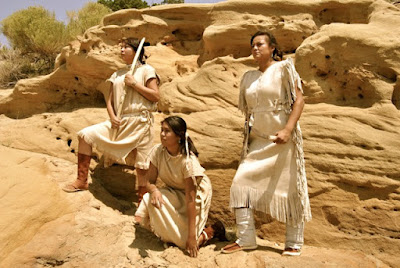
Three young Dine girls escape being captured by Ute trackers and oncoming U.S. military cavalry "The Great Chacoan Escape" (Pictured: Lawana Castillo, June Winters, and Lavencie Cayaditto).


Ute warrior poses (Pictured: Christian Walters).


Ute tracker searches for Dine families and leads U.S. military to homesteads (Pictured: Andrew F. Begay).


Dine female character reacts to warriors advancing up a trail (Pictured: June Winters).

1864 area militia join the U.S. military on the Navajo Long Walk campaign (Pictured: Lee Johnson).

1864 area militia join the U.S. military on the Navajo Long Walk campaign (Pictured: Lee Johnson & Manuel Ornelas).

Pictured: Manuel Ornelas

Pictured: Manuel Ornelas

Pictured: Lee Johnson

Pictured: Andrew F. Begay, Director/Writer Kialo Winters, Producer Allison Tachine

Two warriors collide during a choreographed fight scene (Pictured: Christian Walters & Robert Tsinnajinnie).

Female character preps for a scene where she is shot in the shoulder (Pictured: Director/writer Kialo Winters & Lavencie Cayaditto).

Male character returns to the seet after lunch break (Pictured: Robert Tsinnajinnie).

Female character poses before her scene (Pictured: June Winters).

Male character humors everyone with his zombie take (Pictured: Christian Walters).

The two tangle clan brothers exchange production notes for the day (Pictured: Robert Tsinnajinnie & Kialo Winters).

Cast and crew take lunch break (Pictured: Co-Producer - Allison Tachine, grip Elden Morgan, Robert Tsinnajinnie, Seamstress - Novalene Castillo-Meyers, Christian Walters, Kialo Winters, Andrew F. Begay).

Ute warrior tracker aims and fires at a Dine warrior (Pictured: Andrew F. Begay & Harriet Otero).

Female Dine character is prepped for a scene (Pictured: Harriet Otero).

Characters rehearse their scene (Pictured: Director/writer Kialo Winters, Lawana Castillo, and Robert Tsinnajinnie).

A Dine female character and Ute warrior fight during a choreographed scene (Pictured: Lavencie Cayaditto & Christian Walters).

Choreographed fight scene with actors.

Director/writer Kialo Winters captures the point-of-view of the Ute Warrior.

Choreographed fight scene with actors.

Set location, Ojo Encino, New Mexico USA

Kialo Winters going through production expectations and safety procedures.

June Winters and Lavencie Cayaditto pose for a photo-op.

Kialo Winters helps with actor outfits.

Tuesday, August 7, 2012

Wardrobe: The Great Chacoan Escape (2012)

We are making every effort to keep authenticity a priority when selecting wardrobe. Working with a small budget, we are relying on friends of the community to donate their items for the film shoot. We are very fortunate to have found Novalene Castillo-Meyers, a local seamstress who offered her skills for this project.


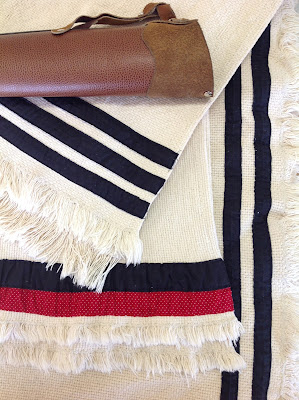
Photo 1: Dine loin cloth (Credit: Novalene Castillo-Meyers)

This cloth shows simple designs for the Navajo characters. The red striped cloth will be worn by the Ute warrior and more complex designs will be added. The cloths pictured are soaked in coffee to show age and we are aging them more for a harsh leathery look.

Photo 2: Navajo quiver

Pictured in photo [1] with the cloths is a modern arrow quiver. Our seamstress, Novalene made a pair of deerskin quivers using it as a model above.


Photo 3: Dine moccasin (Owner: Novalene Castillo-Meyers)

Today, many Dine families own moccasins for traditional and personal reasons. Moccasins are made using deerskin and have tough treadless soles. String or buttons tighten this footwear to be comfortably worn. Very few people know the art of designing moccasins and are purchased from retail stores.


Photo 4: Navajo short bow with arrows (Owner: Allison Tachine)

Navajo short bows were used in close quarter fighting and hunting. Sinew strings and oak rods are used The rods are approximately 4'-5' in length. Salt reeds and turkey feathers are used to make arrows.


Buckle worn by a New Mexico militia character.


Photo 5: Deerskin dress (Credit: Novalene Castillo-Meyers)


Location Scouting: The Great Chacoan Escape (2012)

. : : Under Construction : : .

The summer has been a busy one for all creative minds involved here in Ojo Encino, New Mexico USA. The producers, Terri Winters, Robert Tsinnajinnie, Allison Tachine, and I have been prepping for upcoming film shoots. We want to keep all film scenes within the Na' Neelzhiin (Torreon, NM) area. With the help of my nephews and friends we found ideal areas for the shoot.


 Kialo Winters (L) and Calvin Walters (R) Photo credit: Chris Walters
Scene:  Messenger Runner travels over a rise and contemplates a strategy to elude pursuing rogue Navajo warriors.

Photo credit: Kialo Winters
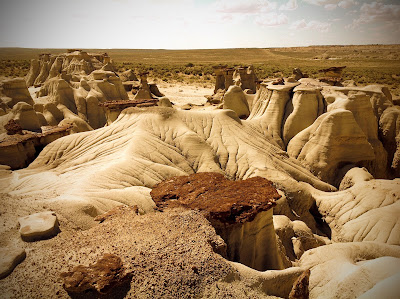
Scene: Location set amongst these hoodoos for upcoming fight scene between a teenage Navajo girl and a Ute warrior.

Photo credit: Kialo Winters
Scene: Location for Navajo warrior to exit cave while being chased by rogue warriors.


Friday, October 14, 2011

The Story


My ancestors escaped the U.S. military’s attempted genocide of the Diné culture in 1863, in the months leading up to what is called “The Long Walk” (1864). The Long Walk was the forced deportation of the Navajo People by the U.S. government in 1864 and is also referred to as "Hweelde". Navajos were forced to walk for 450 miles at gunpoint from their homes in what is now the Navajo Nation reservation to a place called Bosque Redondo, in eastern New Mexico. Many died along the way from cold, starvation and murder. Many more died in Bosque Redondo from starvation, lice, vermin and disease.

In the months before The Long Walk, the U.S. military began their sweep south, from the San Juan basin through what is called Dinetah, the land of The People (the Navajo). A small U.S. military cavalry arrived at a homestead located in the east plains at the base of the Chuska mountains. A tracker led the group to this location where a family of six lived. After attempts to seize the household and deport the occupants failed, the parents were murdered. Three children, with an infant, fled east by foot.

A few military individuals separated from this cavalry to capture the children. The pursuit turned to a 300-mile trek along the Colorado plateau where the children hid among vast crevices, boulders and gorges. During the pursuit, the siblings’ infant brother died of malnutrition and they were forced to bury him in a crevice in a sandstone wall-face in the plateau. A 17- and 15-year-old and their nine-year-old sister survived. They continued fleeing east and made their way into what is currently the Cibola National Forest, along the Mt. Taylor mountain range. There the 15-year-old was attacked by a bear and killed while gathering firewood. The remaining two girls decided to leave the safety of the forest not only because the killer bear was in the vicinity but it was taboo to be near such an episode of death.

The two girls fled northeast onto the farmland of the Pueblo of Zia. Here a Zia Pueblo farmer found the girls on his crop field, took them home and hid them. The pursuing military tracked the two girls into the Pueblo and searched the homes. The farmer and his family hid the two girls in a woodbox under beddings and blankets. The girls miraculously escaped detection and the military party continued on toward Bernalillo, New Mexico. The two girls, Glinibah and Pablita, were adopted by the pueblo and raised as its own, learning the language and customs. The youngest girl, Pablita, married a Pueblo man with the last name Medina and they had a daughter, Loli, together. Loli married a Pueblo man named Jesus Salaz and they had two sons. Loli and her sons were baptized in the Pueblo Catholic Church and were given names of Polito and Frank Montoya. Polito Montoya had 12 children, 48 grandchildren, and 94 great-great grandchildren. I am one of his grandchildren.
Thursday, December 23, 2010

Tracks...of Man & Animal


Often I hear the coyotes howling, yelping and barking early mornings or during odd times of the day. I see the occasional coyote track while running and wonder at their hunting strategies. Not only do they scavenge carcasses but I'm sure they put themselves into organized hunting packs. I've seen my dogs Trevor, Lady and Flo do this as I run the trails. Trevor the alpha male would be in the center while his two ladies are at either side. Trevor would flush out the cotton tail rabbits then Lady and Flo would follow chase.  While driving to work one early morning I saw three coyotes in the distance traveling in this form obviously tracking a predator. Seconds later they gave chase to a jack rabbit.

I'm an avid reader of Louis L'amour books and many military autobiographies. I find it deeply interesting to read how a tracker walks the earth and leave little signs of their passing through. The Native American culture consists of expert trackers throughout history on the north and south american continents. Currently the Shadow Wolves patrol our southern borders which consists of a dozen Native American "...law enforcement professionals who use time-honored tracking traditions". How do professional trackers move without anyone knowing they traveled through the area? As a tracker what signs do you look for when tracking? 'Time-honored' is correctly stated when a student learns from the master.

My novel consists of three teenage girls trekking approximately 200 miles along a ridge of the Chaco plateau. The time is around 1860 when the U.S. military initiates their quest to 'control' the Navajo people from unlawful raiding, stealing, intimidating and murdering peaceful families in the southwest region. The girls escape the initial capture on their homestead and head north. They travel along a ridge of the Chaco plateau and are tracked by a veteran tracker of the Ute nation contracted my the military. How does one travel as a group and beat an expert tracker?